
Why Aren't Teenagers Working Anymore?
May 31, 2026
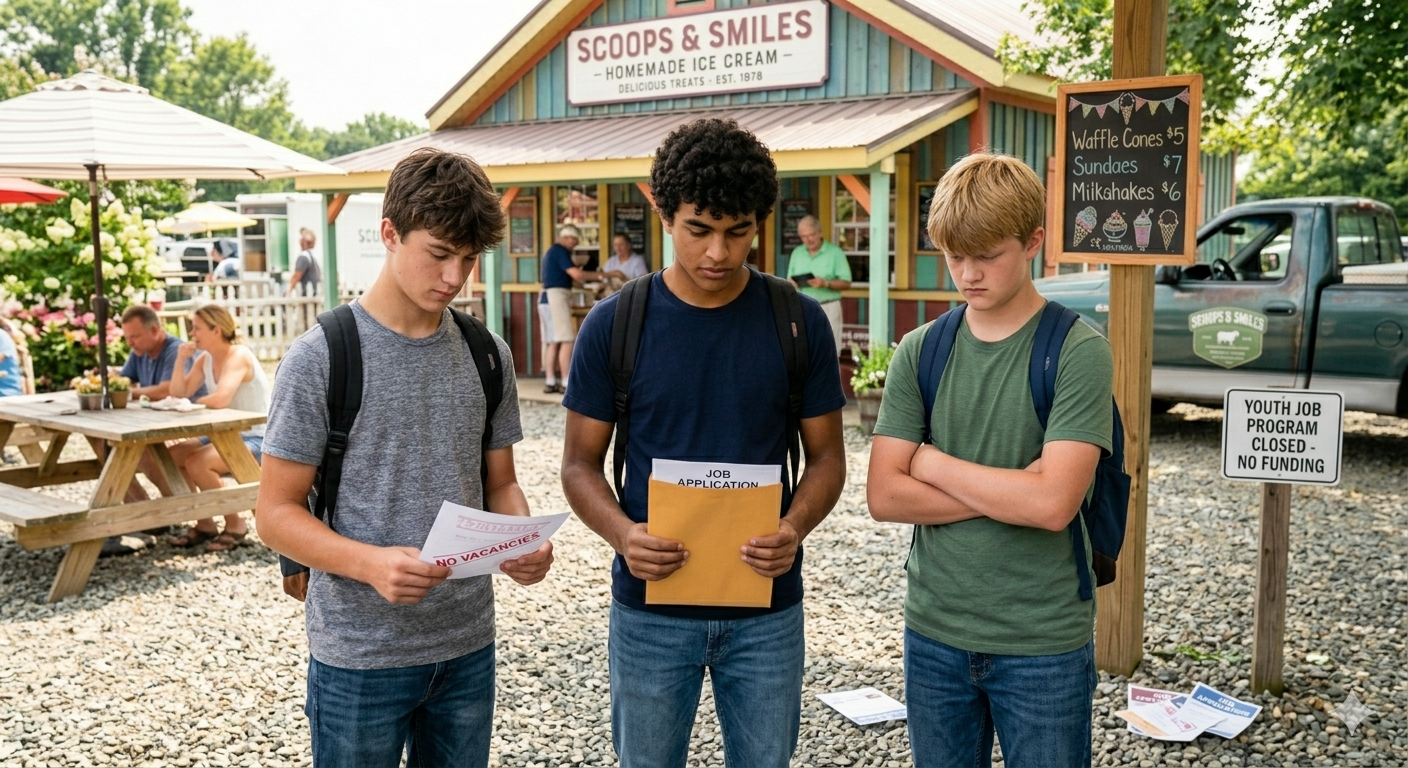
As summer approaches, most teenagers aren't headed to work. For generations, a summer job was practically a rite of passage — a first taste of real responsibility, real money, and real consequences. But that picture has been fading for decades. Today, fewer teens are working than at any point in modern history, and the reasons why say something important about shifting economics — and about how many parents and teens have come to see a teenager's time as better spent elsewhere.
____________
By the Numbers
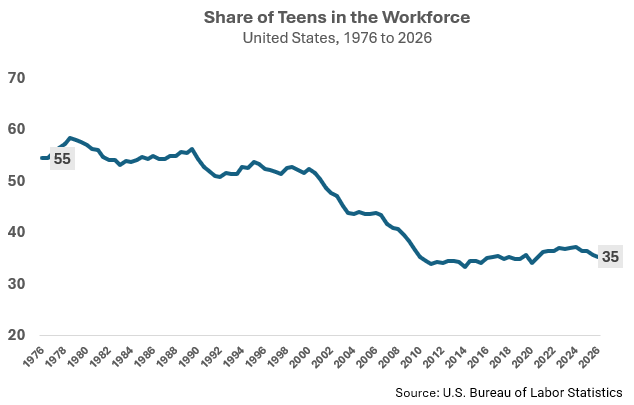
The decline in teen employment isn't a temporary dip. It's a generational shift. In 1976, roughly 55% of American teenagers between the ages of 16 and 19 were active in the workforce. By 2026, that figure had fallen to just 35% — a drop of more than a third over fifty years.
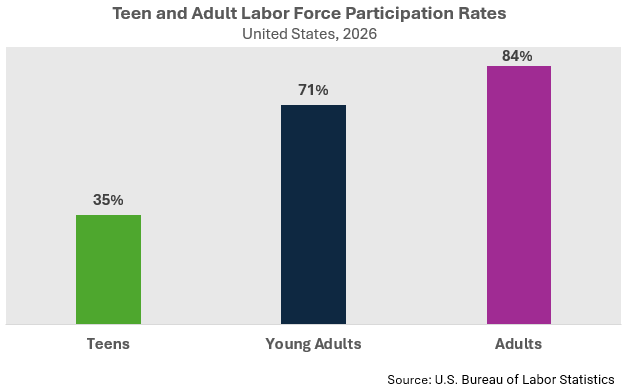
To put that in context: today, teens participate in the workforce at roughly half the rate of young adults (ages 20–24, at 71%) and well below prime-age adults (ages 25–54, at 84%). The gap isn't just about teens being young — something structural has changed.
____________
California: The Worst in the Nation
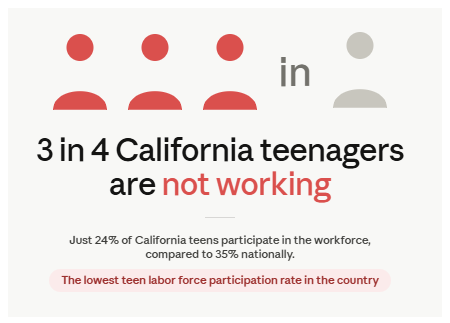
Nowhere is this more pronounced than in California. The state currently has the lowest teen labor force participation rate in the country — just 24%, compared to 35% nationally. That means roughly three out of every four California teenagers are not working, not looking for work, and not counted among the employed.
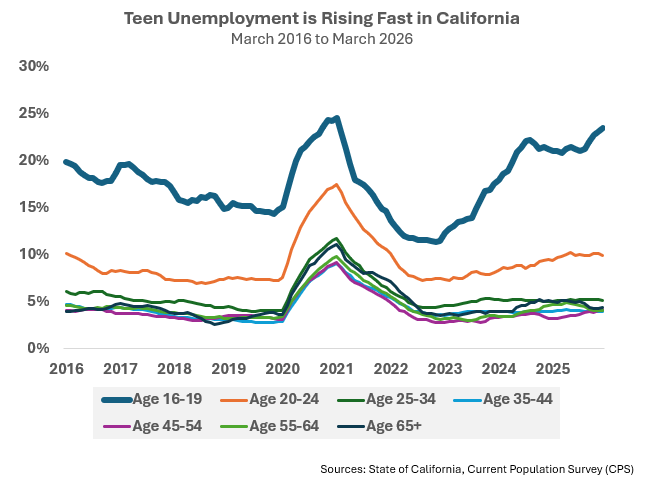
And for those who are trying to find work, the challenge is growing. California's teen unemployment rate — which measures teens who are actively looking but can't find jobs — has climbed to its second-highest level in a decade, surpassed only by the Covid-era spike in early 2021. What makes this particularly notable is that unemployment rates for other age groups have been rising only modestly by comparison. Teens are being squeezed from both ends: fewer are looking, and those who look are having a harder time finding work.
____________
Why Is This Happening?
There are many factors behind the decline in teen employment, but two stand out.
The Economics Have Changed
As the chart below shows, California's minimum wage has risen dramatically over the past three decades — but the pace accelerated sharply starting in 2016, when the state raised the floor to $10 an hour and committed to annual increases every year since.
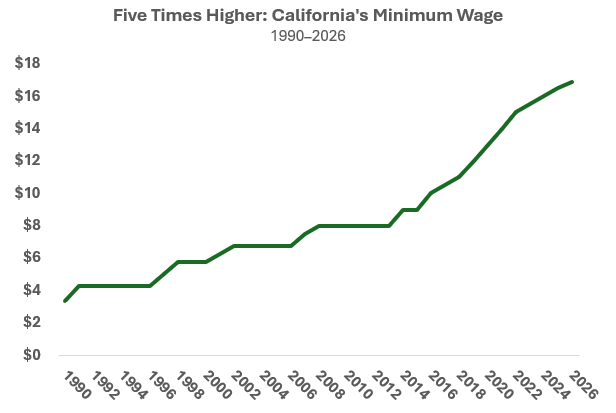
That steady climb — now reaching $20 an hour for fast food workers — was designed to uplift low-wage workers. But it has also changed the math for employers deciding who to hire. When labor costs are high, a small restaurant or retailer will often opt for an experienced adult over a 17-year-old with no track record. Others have accelerated automation — self-checkout kiosks, digital ordering systems — eliminating entry-level positions altogether. The result: teenagers are increasingly being priced out of the jobs that once were made for them.
When Resumes Replace Paychecks
The culture around what teenagers should be doing has also shifted. The hyper-competitive college admissions landscape has changed how families think about a young person's time. Summers are now for competitive sports, SAT prep, enrichment classes, and volunteer hours — not earning a paycheck. Parents and students are responding rationally to real incentives, but the cumulative effect is that hundreds of thousands of teenagers have been steered away from paid work entirely. Many of those unpaid extracurriculars, ironically, teach far less about navigating a workplace than a summer job would.
____________
What Teenagers Miss When They Don't Work
Teen work experience pays dividends that go well beyond a paycheck. Those who do work gain things no classroom easily replicates: how to show up consistently, take direction, recover from mistakes, and earn trust. Research consistently links early moderate employment to better long-term earnings, financial literacy, and a smoother entry into the workforce.
The stakes are only growing. As AI transforms the job market, adaptability and real-world experience will matter more than ever. Those who miss out on that foundation may find themselves less prepared for a workforce that is changing faster than any classroom can keep up with.
____________
The Bigger Picture
None of this is an argument against academic achievement, athletics, or extracurricular involvement. But the data suggests we've tilted so far in one direction that an entire generation of young people is growing up without a basic experience that used to be considered normal — and important.
The teen employment decline isn't just an economic story. It reflects something deeper about how we've come to think about adolescence — and what we've quietly stopped expecting from it.
As summer arrives and the question of how teens will spend their time comes back into focus, it's worth asking whether the traditional summer job deserves a second look — not as a last resort, but as something genuinely valuable in its own right.
