
The $40,000 Entry Fee: College Golf's Recruitment Reality

For decades, college golf operated as a developmental sport—a landscape where talented players from diverse backgrounds could earn roster spots and refine their skills over four years. Recent regulatory changes have fundamentally altered this model.
In 2026, the college golf landscape presents new structural realities: nine roster spots per team, approximately 1,800 active transfer portal listings, and recruitment-related costs that can reach $40,000 annually.
As the House v. NCAA settlement reshapes collegiate athletics, the sport faces significant economic and competitive shifts. Athletes who cannot contribute immediately to team performance face limited roster opportunities, while those without access to national-level competition may struggle to enter the recruitment pipeline. This article examines the data underlying these changes and their implications for the college golf ecosystem.
____________
What Changed: The House Settlement Reshapes College Golf
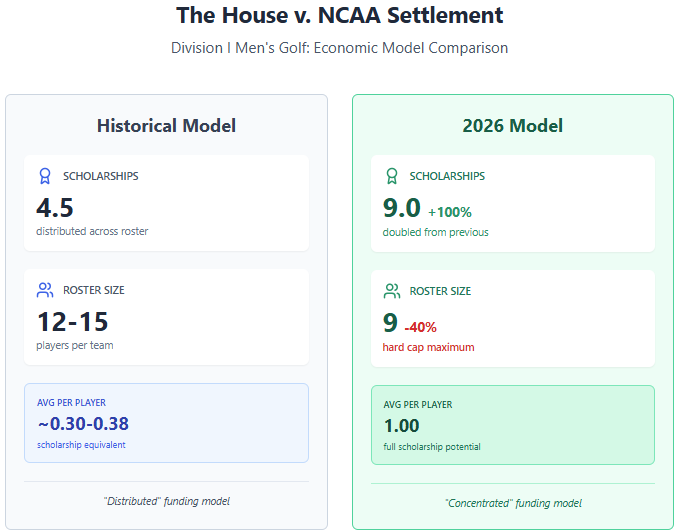
The House v. NCAA settlement represents a landmark antitrust agreement that replaces traditional scholarship caps with mandatory roster limits. For college golf, this change eliminates the "equivalency" model—where coaches distributed 4.5 scholarships across 12 or more players—and introduces a hard cap of nine total roster spots, each of which can be fully funded. This transition effectively moves the sport from an amateur developmental framework to a more professionalized system where each roster position carries significant financial weight.
____________
The Roster Paradox: More Funding, Fewer Opportunities
This fundamental shift has created an economic paradox in the sport. While scholarship limits have doubled to 9.0, the simultaneous implementation of the nine-player hard cap has produced a counterintuitive result: although top recruits can now secure full scholarship packages, the total number of Division I roster positions has contracted by an estimated 10% nationwide, with more substantial reductions of 20% to 25% occurring among high-major programs that historically maintained larger developmental rosters.
____________
No More Late Bloomers: The Demand for Immediate Performance
The most significant impact of these regulations affects walk-ons and late-developing players. Under the previous model, coaches could support athletes over multiple years, allowing for physical maturation and competitive growth. With only nine spots available, programs increasingly require players to contribute immediately to team success. The system now prioritizes athletes who can demonstrate immediate value from their first day on campus, creating pressure to identify "ready" players rather than developing potential over time.
This emphasis on immediate results has elevated the strategic value of existing college players with verified performance records over high school recruits with projected potential. This shift in recruitment strategy is most visible in the increased utilization of the Transfer Portal.
____________
The Transfer Portal Effect: High Schoolers vs. Proven College Players
The Transfer Portal functions as a digital marketplace that allows college athletes to notify their current institution of transfer intent. Originally designed to streamline the transfer process, it has evolved into a central mechanism for roster construction.
As teams reduced rosters to meet the new nine-player limit, hundreds of experienced athletes entered the portal seeking new opportunities. This has created intensified competition: coaches now regularly compare a high school recruit's junior tournament performance against the established collegiate records of transfer candidates.
Why Coaches Choose Transfers: Proven vs. Projected Performance
Coaches increasingly frame roster decisions through a risk mitigation lens. Because junior golf scoring averages typically increase when players move to longer, more challenging collegiate course setups, transfer athletes offer more predictable performance projections:
The High School Recruit: A 70.0 junior average is typically projected to translate to a 72.5+ average in the college environment.
The Transfer: A 71.5 average achieved in actual collegiate tournaments provides verified, lower-risk performance data.
Growth in Transfer Portal Utilization
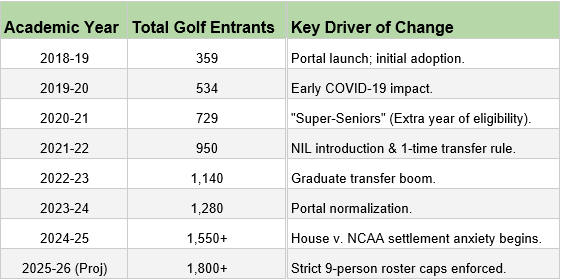
Sources: NCAA Transfer Portal, ForeCollegeGolf, College Golf Commits, and Junior Golf Hub
Portal entries have surged from 350 to 2,000 since 2018, with 2025-26 showing the largest single-year jump. This creates cascading effects: Power 4-caliber recruits shift to mid-majors, mid-major candidates face competition from both high school athletes and D1 transfers, and coaching resources reallocate from recruiting to roster retention.
The net result is intensified competition at every division level for fewer total roster spots.
____________
Breaking Down the $40,000: Where the Money Goes
Getting recruited to Division I requires competing in national junior tournaments, creating a financial barrier that limits access for many families.
The National Tournament Price Tag
To be visible to college coaches, athletes must compete in tournaments sanctioned by the American Junior Golf Association (AJGA)—the premier junior golf organization whose events coaches actively scout and whose rankings carry the most recruiting weight. The cost breakdown for a competitive recruit includes:
Tournament Access:
· AJGA "Junior Plus" membership: $295/year
· Tournament entry fees: $295 per event
· Qualifier fees: $95 per event (often required)
· Travel, hotels, meals for tournament events: $10,000-$25,000/year
Development & Technology:
· Elite instruction and coaching: $3,000-$10,000/year
· Equipment and training aids: $3,000-$5,000/year
· Launch monitor technology (increasingly required): $500-$15,000 plus $200-$500/year in software subscriptions
Total Annual Cost: $20,000-$40,000+
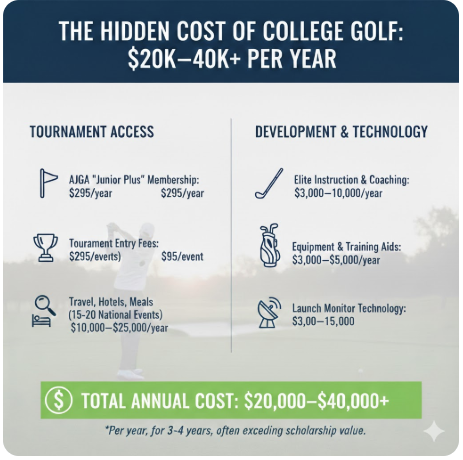
These costs create a significant hurdle for the average household. With the median U.S. family income at $105,800, a competitive golf budget of $20,000 to $40,000 consumes 19% to 38% of total pre-tax earnings. When the "buy-in" for recruitment requires nearly forty cents of every dollar a median family earns, it prices out the majority of talented athletes. This cost narrows the field to a small economic group before competition even begins.
____________
Beyond the Numbers: The Pressure of Professionalization
The financial and structural changes to the game have created a high-pressure environment for junior athletes that extends beyond the scorecard.
Accelerated Timelines: Evaluation now begins as early as age 13. The compression of the recruiting timeline means young athletes often play at elite levels for years before they even reach high school graduation.
Investment Stakes: When a family invests heavily to maintain participation, tournament results can carry a heavier weight, creating a high-stakes focus on performance, often leading to increased performance anxiety.
The Replaceability Factor: The transfer portal has introduced a sense of instability. High school recruits recognize that even a secured spot is fragile; the awareness that they could be replaced by a veteran transfer at any time changes their relationship with their team and their identity within the sport.
Conclusion: Navigating the 2026 Landscape
The convergence of reduced rosters, the growth of the transfer portal, and rising costs has fundamentally restructured college golf. Success now requires families to be as strategic with their resources and athlete development as they are with their data.
While college golf is working to adapt to these changes, the current reality is clear: the path to the next level is narrower, more expensive, and more competitive than ever before.
In loving memory of Jim Collins: a devoted coach, a mentor to many, and a friend.
