
Bay Area Youth: The Rebound

As we begin 2026, we want to highlight some encouraging "green shoots" appearing for Bay Area youth. While significant challenges persist—online dangers, social media pressures, intense academic competition, and identity questions—it's equally important to recognize areas of genuine progress.
Two areas stand out as trends reversing course: education and emotional wellbeing. Though much work remains, community efforts and a more stable post-COVID environment are showing measurable results.
The data tells a compelling story: students are returning to school, stabilizing academically, and making profound, life-changing gains in mental wellbeing.
____________
Education
The academic recovery shows up in three key ways: students returning to the classroom, gradual improvements in reading, and stronger gains in math.
Chronic Absenteeism: The Foundation of Recovery
Chronic absenteeism is defined as missing 10% or more of the school year—18 days out of 180, or about two days per month.
Why it matters:
• Academic gaps widen when students miss sequential instruction critical for mastering subjects
• Social isolation increases as students lose peer connections and adult mentorship
• Serves as an early warning sign for deeper issues like housing instability or curriculum disengagement
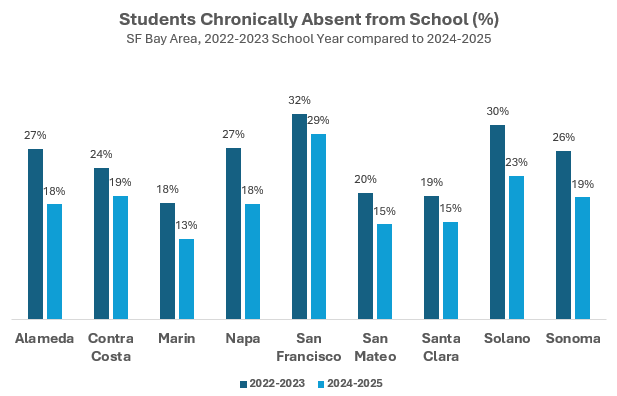
The turnaround: The Bay Area has seen a remarkable 23.3% decline in chronic absenteeism—from 24.3% in 2022-23 to 18.6% in 2024-25. This represents thousands of students returning to the classroom. This trend is consistent across all counties, with the largest improvements in attendance occurring in Alameda and Napa.
Source: California Department of Education
This rapid attendance improvement is the engine that will likely drive even stronger academic gains in coming years. While proficiency increases are incremental, this foundation is essential for sustained progress.
____________
Reading Proficiency: Early Signs of Recovery
With improved attendance and intensified efforts by educators and community partners—including new teaching methods and targeted support for struggling readers—we're seeing the first signs of improvement.
Bay Area reading proficiency (2023 to 2025):
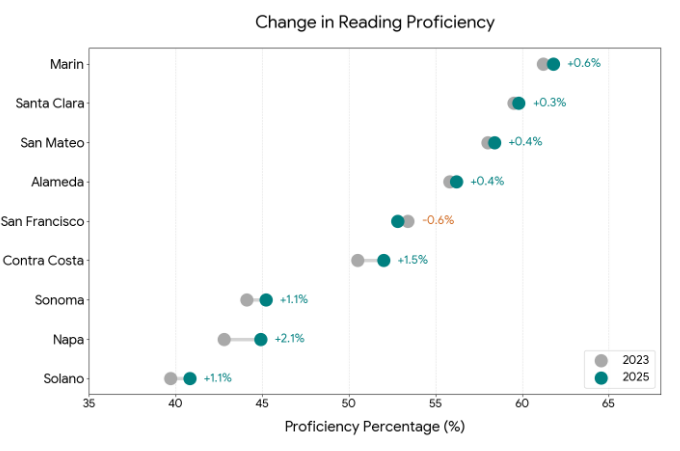
• Overall scores increased from 54.1% to 54.6%
• Positive improvements in all counties except San Francisco (declined 0.6%)
• Largest gains in Napa (+2.1%) and Contra Costa (+1.5%) counties
Source: CAASPP
Math Proficiency: Consistent Regional Progress
Math scores show stronger, more uniform improvement:
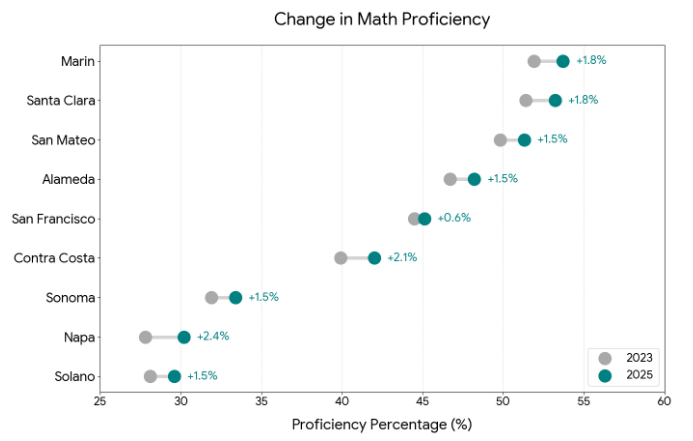
• Overall Bay Area scores increased from 44.6% to 46.2%
• All counties showed meaningful increases
• Largest gains in Napa (+2.4%) and Contra Costa (+2.1%); San Francisco (+0.6%) showed the smallest increase
Source: CAASPP
While significant work remains—these trends signal stabilization and the beginning of recovery from years of decline coupled with pandemic learning loss.
____________
Student Wellbeing
Remarkably, even while students face mounting digital risks—social media addiction, AI exposure, online dangers—and intense pressure to succeed, their mental health has improved significantly since the pandemic's darkest days.
The following data comes from 11th-grade student surveys conducted by the California Department of Education, comparing 2021-2023 results to 2023-2025.
Chronic Sadness: Major Regional Decline
Chronic Sadness: Major Regional Decline
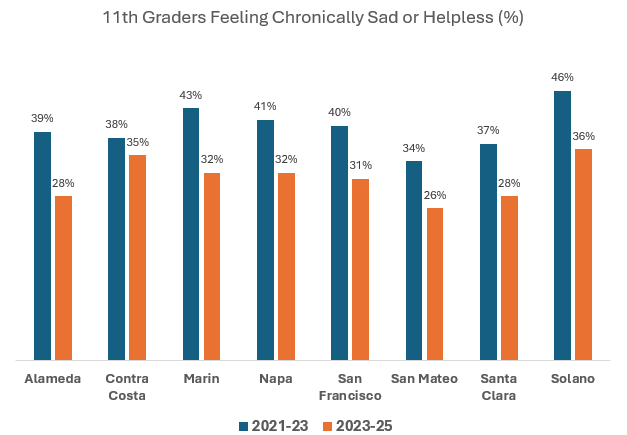
The improvement in students' baseline emotional health is significant. The percentage reporting chronic sadness or hopelessness over the past 12 months:
In the Bay Area, it has dropped from 39% to 30%, a 22% rate of decrease
Most counties achieved substantial double-digit or near-double-digit decreases
Largest declines: Alameda, Marin, and Solano (10-11 percentage points each)
Source: CalSCHLS
Suicidal Ideation
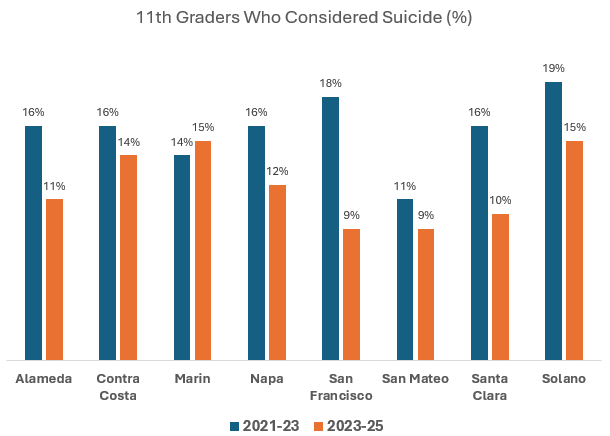
Even more encouraging, the data shows meaningful declines in suicidal ideation. Seven of eight counties saw decreases in students reporting they considered suicide:
• San Francisco led the way, cutting its rate in half—from 18% to 9%
• Santa Clara saw a 6-point drop (16% to 10%)
• Alameda saw a 5-point drop (16% to 11%)
• Only Marin County saw an increase (1 percentage point)
Source: CalSCHLS
____________
Conclusion: Encouraging Signs of Recovery
After years of discouraging trends, the data reveals Bay Area youth are recovering on multiple fronts:
Academic resilience: Students are returning to classrooms in growing numbers—the 23% decline in chronic absenteeism represents thousands of young people re-engaging with school. This foundation is driving stabilization in reading proficiency and stronger, more uniform gains in math across all counties.
Transformative mental health gains: The most dramatic improvements appear in student wellbeing. The sharp decline in chronic sadness (from 39% to 30%) and suicidal ideation represents not just statistical progress but genuine life-changing outcomes.
While these trends offer real reason for optimism, significant work remains—current proficiency rates and mental health indicators are still far below where they need to be. The improvements signal that Bay Area youth are beginning to heal from the pandemic's deepest wounds, but the recovery is uneven. Local variations—such as Marin's unique trends and San Francisco's reading challenges—underscore the need for deeper understanding and targeted interventions.
These green shoots represent real progress—and a call to sustain and intensify our support for Bay Area youth in 2026 and beyond.
