
California Banned Sports Betting. How Are Millions Trading the Super Bowl?
Part I: Understanding the Predictions Market and Its Implications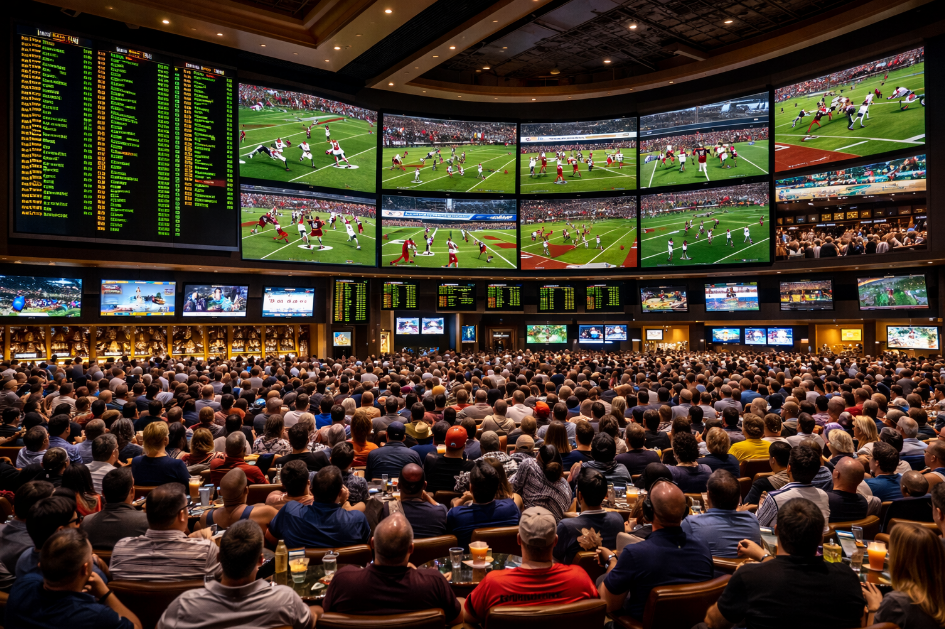
California's voters have twice rejected online sports betting, making it explicitly illegal. Yet right now, millions of Californians are legally betting on the Super Bowl from their phones. It's not just football. Every day, they're trading on thousands of events: presidential elections, economic data, AI releases, even geopolitical conflicts.
Still, approximately 90% of all prediction market trading volume is sports betting, according to Kalshi. While these platforms offer diverse markets, the overwhelming majority of actual trading remains focused on sports—the very activity California voters explicitly rejected.
The mechanism is the prediction market, an industry that barely existed four years ago.
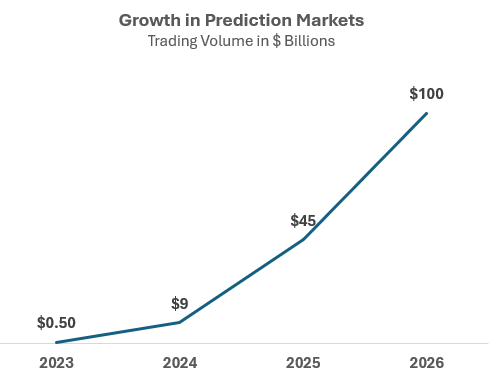
The prediction market has exploded from $50 million in 2023 to over $100 billion in 2026—a 2,000-fold increase in just three years.
Through a legal loophole, what looks, feels, and functions like gambling has been reclassified as 'investing' in derivative contracts, bypassing state gambling bans entirely.
This two-part series examines how the market works and its implications for California. Part I explores the mechanics and rapid growth. Part II will address the darker consequences: the vulnerability of young people and gambling addiction.
______________
How It Works: The $1.00 Rule
In a prediction market, participants are essentially buying a financial contract tied to whether an event happens or not. The mechanics are simple: every contract is worth either $1.00 or $0. The price paid reflects the market's probability that the event will occur. Using the Super Bowl as an example—one could buy a Seahawks contract at $0.68 or a Patriots contract at $0.32. Here's how the game contracts work:
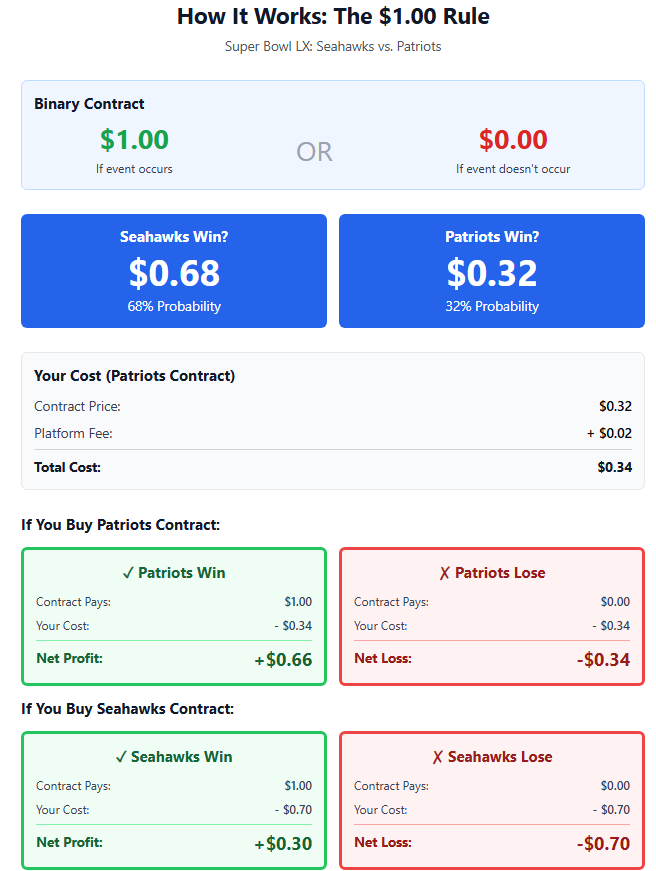
Traders can buy unlimited contracts, scaling their exposure. At $0.34, a Patriots win returns $0.66 profit—nearly doubling the bet. A Seahawks contract costs more ($0.70) but offers less profit ($0.30) due to higher odds. Unlike sports betting, the margin of victory is irrelevant—only whether the event occurs.
Why This Is Different from a "Bet"
In a traditional sportsbook, the Seahawks are -4.5 point favorite. If someone bets on them and they win by only 3 points, the bettor loses. In a prediction market, traders are simply buying the outcome. Whether the Seahawks win by 1 point or 50 points, the contract still pays out the full $1.00.
______________
Beyond Sports: Betting on Everything
While the Super Bowl may be this weekend's biggest headline, prediction markets never close. These platforms have evolved into a 24/7 global scoreboard where traders bet on everything from presidential elections to Oscar winners. Here are some current high-stakes markets:
The 2028 Presidential Election
Even years away, the market is already picking winners. On Polymarket:
J.D. Vance: 28% (leading)
Gavin Newsom: 23%
Geopolitical Conflict
The most controversial market of 2026. Recent odds on which country the U.S. will strike next:
89% probability of Somalia
7% Syria
5% Iran
The AI Benchmarking Race
Tech rankings are also being traded:
Gemini 3 Pro: 96% probability of maintaining #1 on LMSYS Leaderboard through February
Traders betting against last-minute upsets from OpenAI or Anthropic
______________
The Exponential Surge of Prediction Markets
The prediction market has transformed from a niche experiment into a mainstream financial industry. Milestones in its evolution include:
2024: The Foundation
Annual trading volume reached $9 billion
Driven by the U.S. presidential election and federal court rulings clarifying the legal status of event contracts
2025: The Robinhood Effect
Robinhood integrated prediction markets directly into its app, giving 27 million retail investors instant access
Volume surged to $45 billion—a fivefold increase
2026: Acceleration
January alone: $17.5 billion in combined volume across platforms like Kalshi and Polymarket
Even banned sportsbooks like FanDuel and DraftKings entered via prediction market platforms (launched late Dec.)
Projected to exceed $100 billion in total annual volume this year
Event contracts now established as a mainstream asset class
______________
Top Prediction Platforms
The prediction market has consolidated into several powerhouse platforms. While dozens of niche sites exist, these platforms lead the industry in volume, legal standing, and influence.
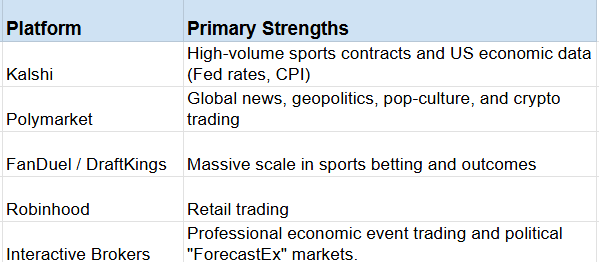
Given the market's explosive growth, other major players like CME Group and Coinbase are developing their own prediction market platforms. Traditional brokerages like Schwab and Fidelity may eventually follow.
______________
The Legal Loophole: How "Finance" Bypassed Gambling Laws
The key issue is how these transactions are legally classified.
Traditional sportsbooks operate as "house-banked gaming," where bettors wager against the house that sets the odds. California prohibits this model. Prediction market platforms structured their operations differently.
Kalshi, Polymarket, Robinhood, and DraftKings Predictions operate under federal oversight by the Commodity Futures Trading Commission (CFTC). By framing bets as "derivative contracts"—financial assets that traders buy and sell from each other, not from a house—they've circumvented state gambling laws entirely.
The legal reasoning: these platforms function like stock exchanges. Traders buy and sell event contracts peer-to-peer while the platform simply facilitates transactions for a fee. Because these "event contracts" fall under federal CFTC regulation, they're classified as financial instruments rather than gambling under state law.
______________
Looking Ahead
California voters have twice banned online sports betting. Yet today, millions of Californians are legally trading on the Super Bowl and thousands of other events through prediction markets—a $100 billion industry that has reframed gambling as "investing" in derivative contracts.
This regulatory loophole has transformed prediction markets from a niche experiment into a mainstream financial phenomenon in just three years. Platforms like Kalshi, Polymarket, and Robinhood now offer millions of users instant access to bet on thousands of events—from sports to presidential elections—all while operating under federal CFTC oversight that bypasses state gambling laws.
But the explosive growth raises critical questions about societal costs. In Part II, we'll examine the risk of gambling addiction among prediction market users and the platforms' appeal to young people. As this industry continues to scale, understanding its darker implications becomes increasingly urgent.
