
California Banned Sports Betting. Nobody Told the 18-Year-Olds.
Part II: California voted no twice. A generation is finding out why
In Part I of this series, we examined how prediction markets sidestepped two California voter referendums by reclassifying 'event bets' as 'derivative contracts,' turning a niche industry into a $100 billion market. The loophole held. The fallout is only now becoming clear.
This second installment examines the human cost — who is trading, what they are losing, and the addiction crisis quietly building behind a $100+ billion industry.
____________
A Generation at Risk
Sports betting and prediction markets skew toward a specific demographic: young men between ages 18 and 34. Within that group, the most vulnerable segment is also the newest — the 18-to-20-year-olds who can legally access these platforms but remain too young to enter a licensed sportsbook.
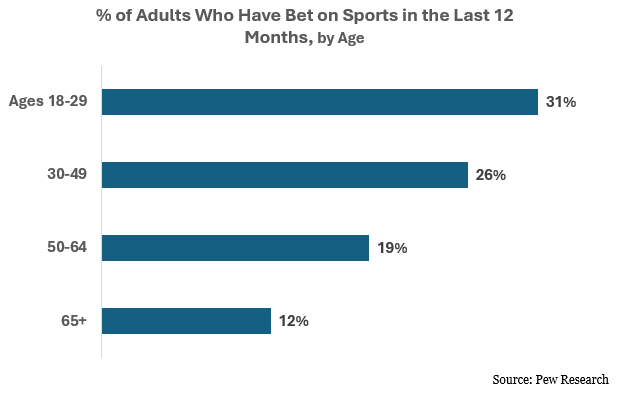
The numbers bear this out. According to Pew Research, 31% of adults ages 18 to 29 — a subset of that demographic — have placed a sports bet in the last year, compared to 12% of those ages 65 and older. The same survey found that 25% of men have placed a sports bet in the last year, compared to 19% of women.
The data makes the risk concrete. A 2024 Fairleigh Dickinson University (FDU) poll found that of online bettors surveyed:
45% of men under age 30 reported at least one problem gambling behavior — including guilt over losses, betting money they couldn't afford to lose, and stress or anxiety related to gambling.
Moreover, the poll found that 10% of these young men scored high enough to indicate a severe gambling problem — more than triple the 3% rate found in the general population.
Overconfidence compounds the risk. The 2025 American Sport Fanship Survey found that 90% of online bettors aged 18–34 believed they could consistently profit from their 'trades,' compared to 66% of those 65 and older — a 24-point gap that widens considerably with youth.
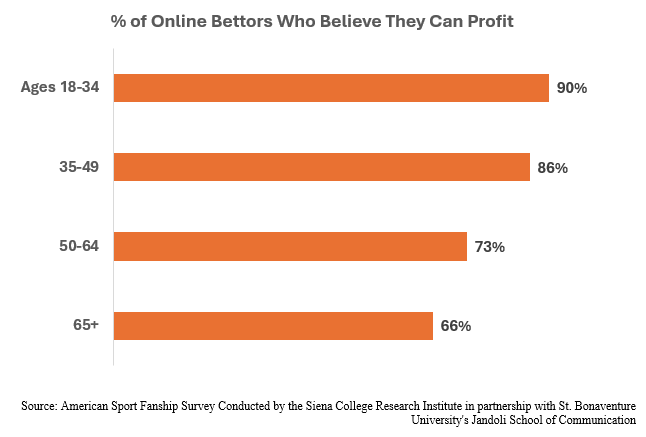
Research repeatedly links this kind of overconfidence to the flawed thinking patterns associated with problem gambling.
The age threshold accelerated the problem. Unlike traditional sportsbooks, which require users to be 21, most prediction market platforms allow accounts for users as young as 18 — a gap analysts at Truist noted has driven significant participation from college students, particularly in high-volatility markets like college football.
____________
The House Always Wins
Prediction markets sell themselves as a thinking person's game — where research and knowledge give you the edge. The actual math tells a different story.
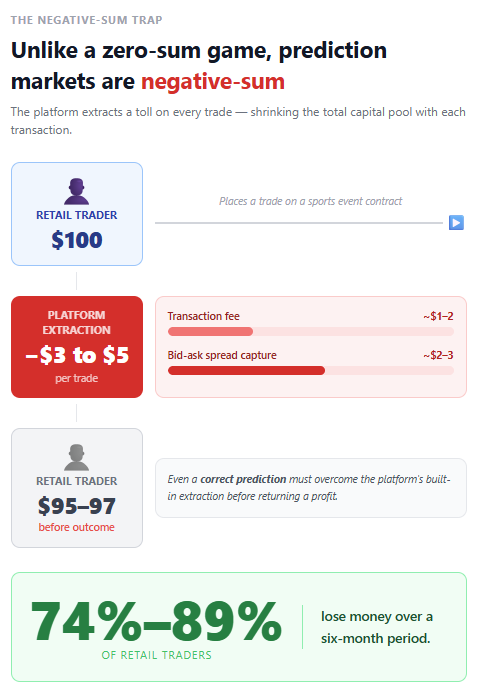
These platforms operate as negative-sum environments. Through transaction fees and the bid-ask spread — the gap between buy and sell prices — the platform extracts a toll on every trade, siphoning principal even when predictions are correct.
The data is clear: 74%–89% of retail traders lose money over a six-month period, according to research from PiP World. This is not simply a failure of research or strategy — it is also a mathematical consequence of overcoming trading costs and competing against professional market-making algorithms in a negative-sum environment.
Losing money is one thing. Not being able to stop is another.
____________
The Addiction They Called Investing
The biggest danger of prediction markets may not be financial. It is psychological. Casinos are obvious. Prediction markets are not. By recasting bets as trades, these platforms have made addiction harder to spot, harder to admit, and harder to treat.
The reason they are so hard to put down comes down to brain chemistry. Every time a contract's price moves — say, from $0.40 to $0.80 during a game — the brain registers a "near win" and releases dopamine. This happens over and over, for hours, on a single trade. A slot machine resolves in seconds. A prediction market keeps the loop running all day.
What makes it harder to recognize as a problem is the research component. Because users can study statistics and analyze trends before trading, they tend to credit their own intelligence when they win — and blame bad luck when they lose. Experts call this the "illusion of control," and it is especially effective at masking addiction among educated, high-earning users.
The real-world costs are beginning to show. A 2025 UCLA study found that in areas where online betting has grown fastest, credit scores have dropped and bankruptcy rates have risen.
As of February 2026, search interest for "gambling addiction" has hit an all-time high of 100 on the Google Trends index, representing a more than 200% increase compared to the stable pre-legalization baselines seen in 2015.
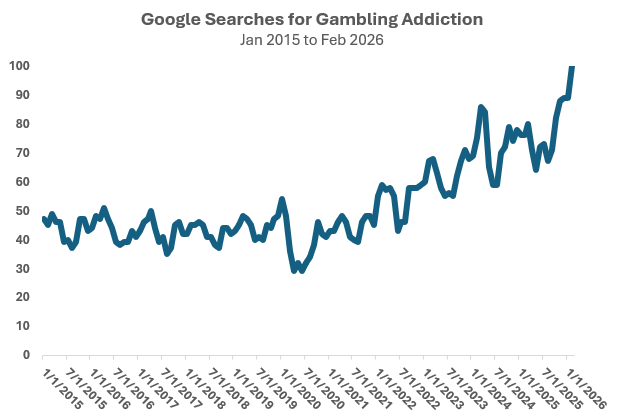
This trajectory shows a relationship between the rise of mobile betting and prediction markets and a burgeoning public health crisis.
Behind that crisis are real people. Gambling addiction carries the highest suicide risk of any addiction disorder — surpassing both alcohol and opioids — and according to research published in the International Gambling Studies journal, each problem gambler directly harms at least six others in their immediate circle. Prediction markets make that harm uniquely difficult to see coming — and with thousands of contracts available around the clock, the conditions for escalation are constant.
____________
Conclusion: The Bet California Tried to Avoid
The regulatory loophole that allowed prediction markets to flourish in California has, in practice, legalized the very activity voters twice rejected. A 130-fold increase in monthly trading volume since early 2024 reflects a system optimized for engagement, not consumer protection.
Prediction markets have effectively built a 24-hour casino in the pocket of every adult Californian with a smartphone — with few consumer protections. The data makes clear who bears the most risk: young men between 18 and 34 are the dominant user group, the most likely to overestimate their ability to profit, and the least likely to seek help.
The legal question has been settled. The public health question has not.
