
No Room Left: War, Inflation, and the Families Who Can't Afford Another Hit
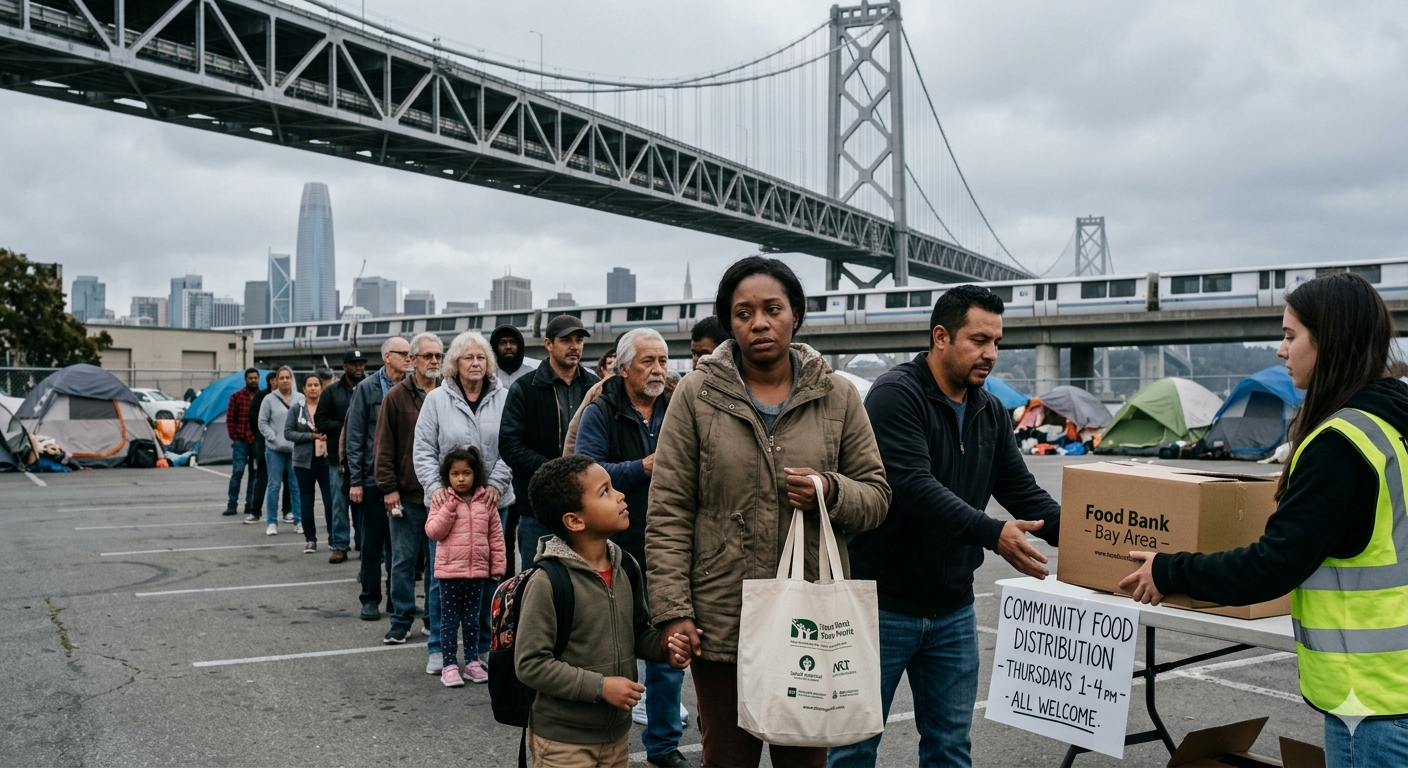
The Bay Area is one of the wealthiest regions on earth. Yet beneath that wealth, hundreds of thousands of families are struggling to get by.
Nearly one in two public school students in the Bay Area qualifies for free or reduced-price lunch.
That tension was already approaching a breaking point heading into spring 2026. Then came the Iran war, and with it, a rapid rise in oil prices, early signs of inflation across everyday goods, and a new wave of financial stress landing on families that were already stretched to their limits.
This analysis reviews what the data tells us about the financial fragility already embedded in Bay Area households — and what early indicators suggest about the mounting pressure now arriving at the gas pump and grocery store.
____________
Already Living on the Edge
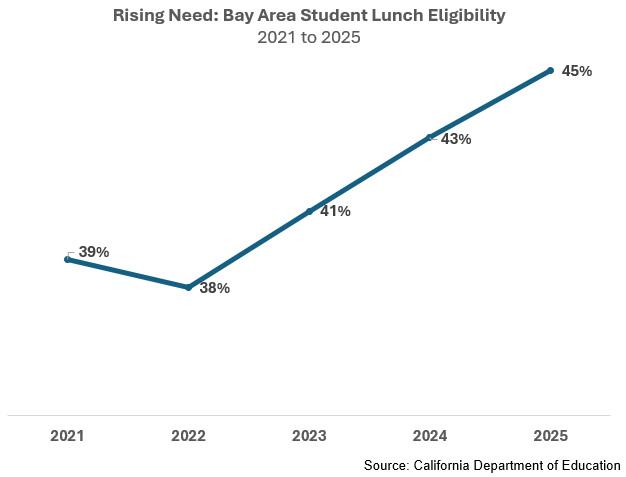
While all California public school students now receive free lunch, the share who qualify under federal income thresholds — families earning below 185% of the Federal Poverty Level, roughly $59,465 for a family of four, remains one of the broadest available measures of economic stress.
45% of Bay Area students qualified for free or reduced-price lunch in the 2024–2025 school year.
That figure represents a 13% increase from 39% just five years earlier — and the trend is moving in the wrong direction.
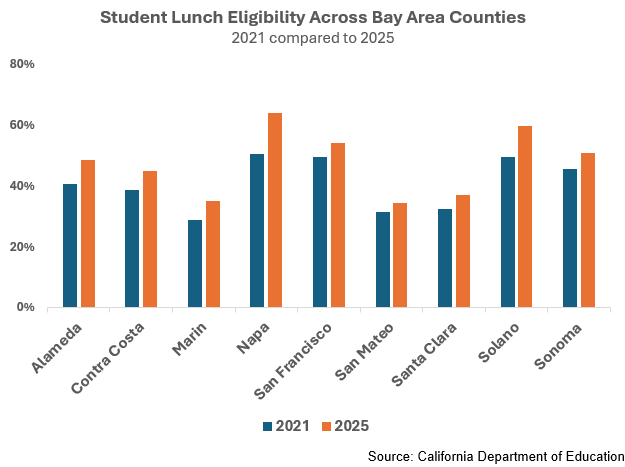
The increase has been widespread, though the impact has not been felt equally across the region. Napa County saw the steepest rise at 21% — and now leads the region with 64% of students eligible, followed closely by neighboring Solano County at 60%.
____________
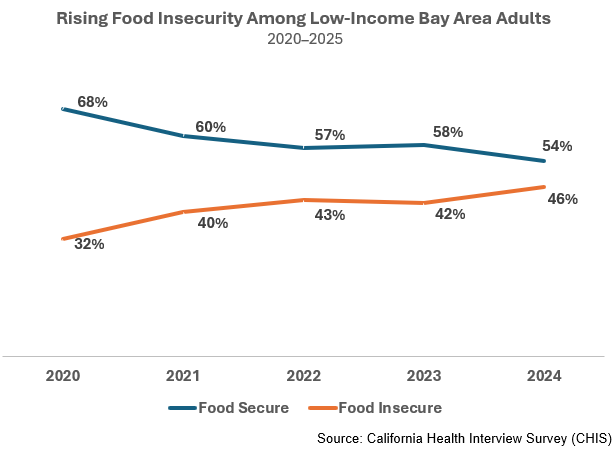
California Health Interview Survey (CHIS) data from UCLA — the most comprehensive state health survey in the country — tells a similar story. Among Bay Area adults living below 200% of the Federal Poverty Level, 46.4% report being unable to afford enough food.
That represents a 45% increase in adult food insecurity over just five years. Today, nearly one in two low-income Bay Area adults regularly struggles to put enough food on the table.
And yet, the safety net is not keeping pace. Only 32% of adults living below 200% of the poverty level qualify for food assistance programs like CalFresh — leaving the majority to manage on their own, earning too much to qualify for benefits but too little to make ends meet.
____________
The Iran War: An Unwelcome Shock
The Iran conflict — which has triggered the effective closure of the Strait of Hormuz, a critical chokepoint for global oil supply — has sent ripple effects through the Bay Area economy that are already being felt in tangible ways.
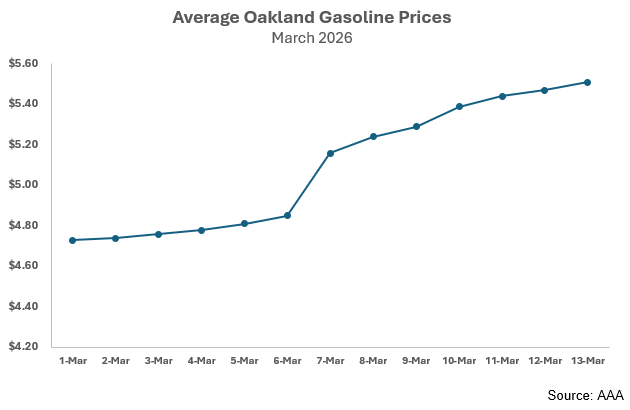
The most immediate impact has been at the gas pump. AAA's tracking of average gasoline prices in Oakland shows the price per gallon rising from $4.73 on March 1 to $5.47 by mid-March — a 16% increase in just two weeks.
For a household already spending $330 to $475 per month on gas, a sustained 20% increase adds $65 to $95 per month — up to $1,100 per year — with no relief elsewhere in the budget.
And gas is just the beginning. Energy costs are embedded in the price of nearly everything — food, shipping, packaging, home heating, consumer goods. When oil prices rise sharply, everything follows.
____________
The Grocery Bill
That lag is already closing. A comparison of Amazon grocery prices from March 1 to mid-March — using Amazon's real-time pricing system, which responds rapidly to cost changes — reveals an 8% increase across a basket of common household staples. The individual item increases are striking:
Eggs: +30%
Frozen berries: +62%
Kettle chips: +32%
BBQ sauce: +30%
Greek yogurt: +25%
Frozen chicken: +7%
Most of these are everyday staples — eggs, chicken, frozen fruit. For the nearly half of low-income Bay Area adults already struggling to afford enough food, a 30% jump in egg prices or a 7% increase in chicken is not an inconvenience — it is a direct hit to an already strained budget. When there is nowhere left to trade down, the choices narrow fast: cut back or lean harder on food banks that are already stretched.
The Iran war is not just a geopolitical event. For many Bay Area families, it is arriving as a direct and immediate financial shock — at a moment when there is almost no room left to absorb one.
____________
The Bottom Line
The data tell a coherent and concerning story. Before the conflict began, nearly half of Bay Area public school students qualified for free or reduced-price lunch — a key indicator of household financial need — and food insecurity among low-income adults had surged nearly 50% in five years. The safety net was already falling short.
Now, an external shock is layering additional costs onto those with the least capacity to bear them. Gas prices are up 16% in just two weeks. Grocery staples are rising sharply, with broader inflation expected to follow.
Community organizations, food banks, and policymakers can expect growing demand for assistance. The need was already great. The Iran war is making it greater.
One way to help: support a local food bank or food distribution nonprofit. The need is growing, and every contribution counts.
____________
