
Detention Up 114%: ICE Enforcement Trends in California and the Bay Area
March 29, 2026
When we published our analysis of immigration enforcement in June 2025, the Trump administration's interior enforcement strategy was already reshaping the landscape for the nearly 500,000 undocumented immigrants living in the Bay Area. Nine months later, that shift has accelerated sharply. California's detained population has more than doubled, deportation orders have hit record highs, and a major new detention facility has opened within the state.
This update examines what the data shows through early February 2026, with a focus on California and the Bay Area. It is also a timely moment to review these trends given the ongoing discussions surrounding ICE.
Over the past 12 months, the number of people held in ICE detention in California has increased by 114% — from 3,024 in February 2025 to 6,459 in February 2026.
_______________
National Context: What Is Driving the Increase
To understand California's numbers, it helps to start with the national picture.
Nationally, total detainees booked into ICE custody peaked at 70,766 in January 2026 before declining slightly to 68,289 as of February 7, 2026 — a 74% increase since Trump took office in January 2025.
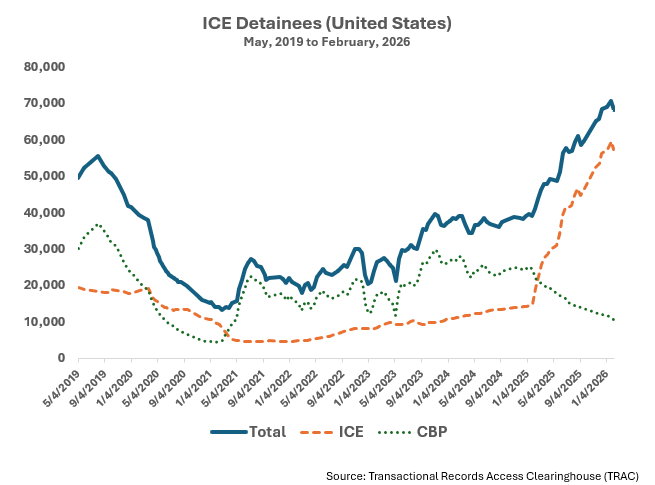
Two factors are driving this national surge:
Enforcement policy: The Trump administration made immigration enforcement a central policy priority from day one, directing significant federal resources toward interior enforcement operations across the country.
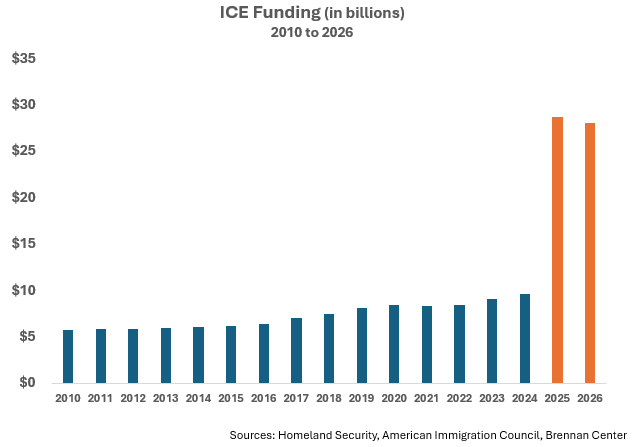
Record ICE funding: The One Big Beautiful Bill Act, passed in July 2025, injected $75 billion into immigration enforcement over four years — effectively tripling ICE's annual budget from roughly $10 billion to over $28 billion annually.
A separate but related shift is visible in which agency is making arrests. As of early February 2026, ICE accounts for 84% of new bookings, with Border Patrol (CBP) responsible for only 16%. This reflects a sharp drop in border crossings — monthly encounters are down 89% compared to the Biden administration — meaning far fewer arrests are occurring at the border itself. The result is an enforcement apparatus increasingly focused on people already living in the United States.
_______________
The California Picture
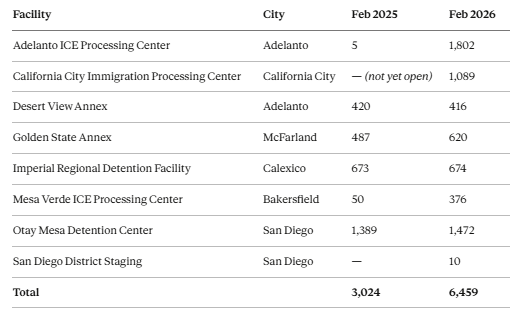
Mirroring national trends, California's detained population grew from 3,024 in February 2025 to 6,459 in February 2026 — a 114% increase in 12 months.
This growth was driven by two factors: rising populations at existing facilities and the reopening of a major new facility, the California City Immigration Processing Center (CCIPC), which began receiving detainees on August 27, 2025.
The table below compares average daily population by facility for February 2025 and February 2026.
The opening of CCIPC reignited a longstanding debate over the use of private prison companies in immigration detention. The facility is operated by CoreCivic (NYSE: CXW) under a contract valued at $130 million annually.
_______________
Record Deportation Orders
While detention data reflects who is being held statewide, deportation orders provide a separate but related picture of enforcement activity at the local level. In 2025, the Bay Area saw nearly 9,500 formal removal orders issued across its nine counties.
California: Record High in 2025
Courts issued 66,089 formal deportation orders in California in 2025 — a 68% increase from 2024.
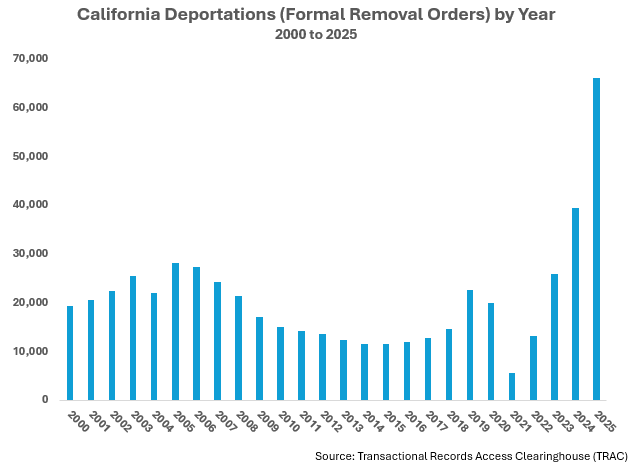
Bay Area: 9,505 Orders in 2025
The Bay Area's nine counties accounted for 9,505 deportation orders in 2025. Santa Clara County led the region, followed by Alameda and Contra Costa.
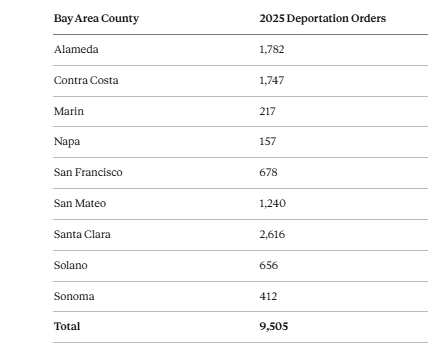
Together, the three largest counties accounted for two-thirds of the region's total.
_______________
Looking Ahead
Despite the increases documented above, the Bay Area has one of the lowest arrest rates per undocumented resident in the country. This reflects the region's local policies limiting coordination with federal immigration enforcement, as well as broader patterns in how ICE allocates resources across the country.
That could change. The federal government has filed lawsuits against multiple jurisdictions seeking to compel greater cooperation with ICE, and the legal landscape remains unsettled. At the federal level, there has also been discussion about deploying ICE agents to support TSA operations at airports — this has not yet materialized in the Bay Area, though Oakland International Airport is worth watching, as it is a federally operated facility where city policies carry less weight. With enforcement priorities, funding levels, and court decisions all in flux, the picture heading into 2026 remains uncertain.
_______________
Conclusion
The data through early February 2026 reflects a significant escalation in immigration enforcement — California's detained population has more than doubled, and Bay Area deportation orders reached nearly 9,500 in 2025. Behind those numbers are hundreds of thousands of individuals and families navigating an environment where the rules continue to shift. How that environment continues to evolve will depend on decisions at the federal, state, and local level that remain unresolved.
