
Pride, Porn, and Kids
July 26, 2026
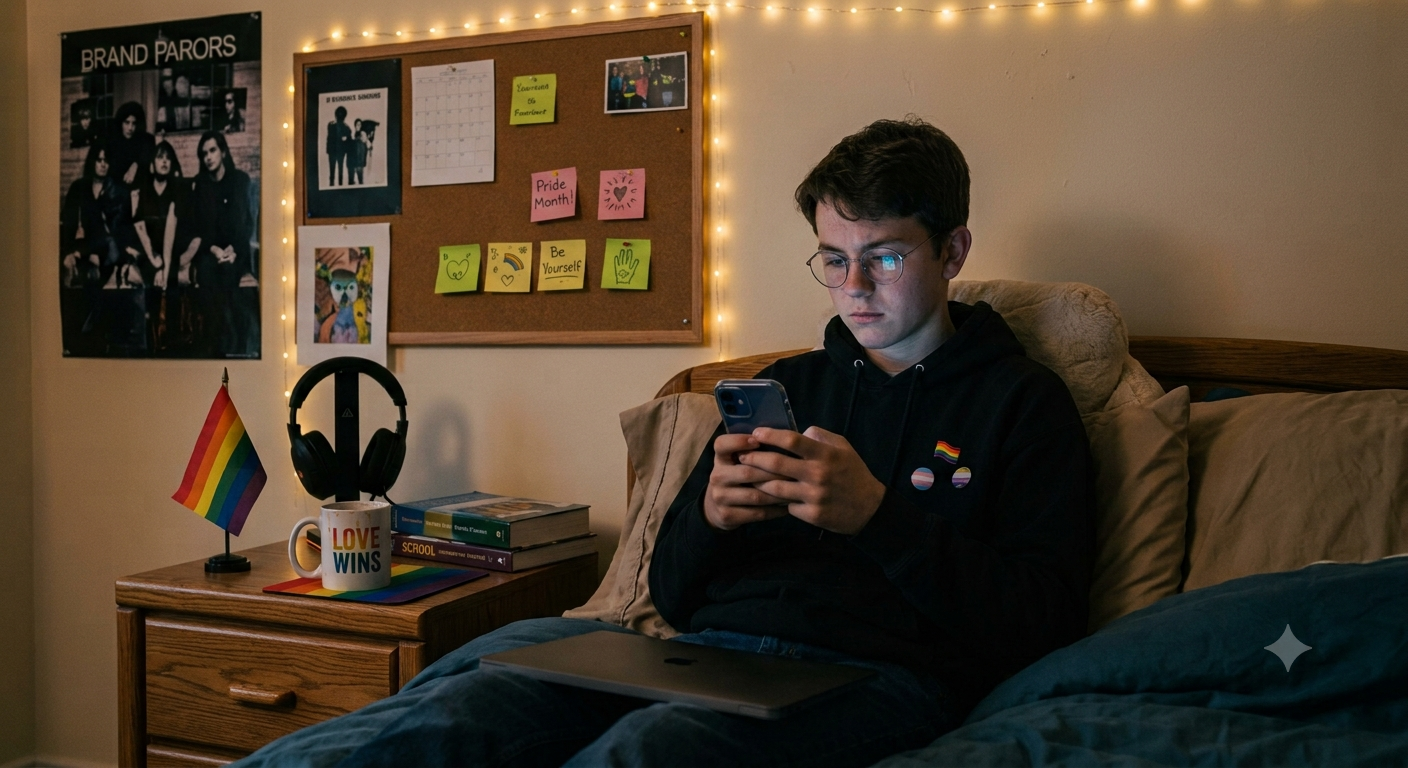
As Pride celebrations wind down each summer, the flags come in and the parades end. What doesn't end is the online crisis quietly unfolding for the very youth those festivities claim to champion. Somewhere behind the rainbow banners, a 13-year-old questioning their sexual identity has opened a browser tab their parents will never see. They're not looking for trouble — they're looking for answers. What Pride often ignores is a striking and uncomfortable truth:
Youth who identify as LGBTQ+ or who are questioning their identity are twice as likely as their peers to be consuming pornography and sexting.
And some of the organizations cheering the loudest may be part of the reason why.
____________
One in Five
According to the California Health Interview Survey, roughly 1 in 5 California teenagers ages 13–17 are navigating questions about their sexual identity or orientation. Ten percent identify as bisexual, 3% as gay or lesbian, and another 8% describe themselves as questioning or something else.
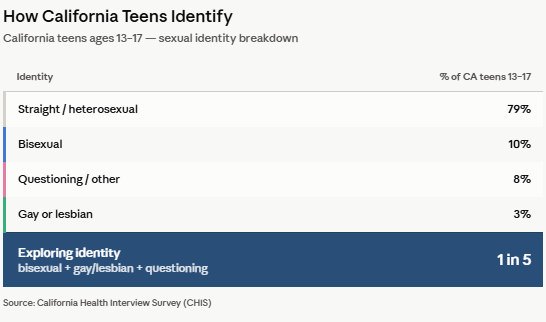
That is not a fringe statistic. It represents hundreds of thousands of young people — and research consistently shows they are significantly more likely to turn to the internet to explore who they are. That decision comes with serious risks — pornography, exploitation, grooming, and bullying — that most parents never see.
____________
Searching in the Dark
When young people begin questioning their sexual identity, the internet is often among the first places they look for answers. They go online — and they go often. Research published in the Annals of Epidemiology using data from the Adolescent Brain Cognitive Development (ABCD) Study found that transgender teens spend an average of 4.51 more hours online per day than their heterosexual peers. Those who describe themselves as questioning their gender spend 3.41 more hours daily.
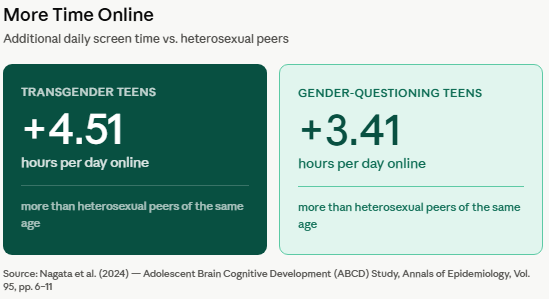
More time online does not automatically mean more risk — but where these youth are going does. Thorn, a nonprofit dedicated to defending children from sexual exploitation, found that youth identifying as LGBTQ+ or questioning are far more likely than their peers to end up in digital spaces designed for adults.
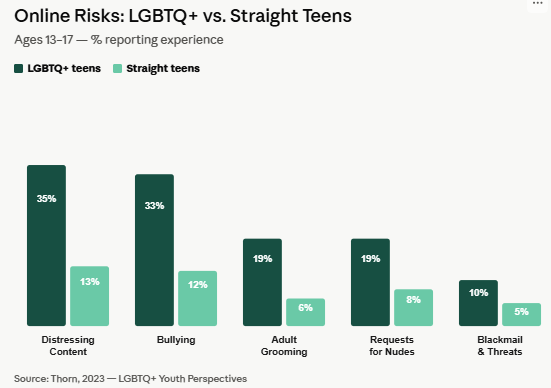
LGBTQ+ teens are twice as likely to maintain hidden secondary social media accounts created primarily to keep content private from parents. On those accounts, they most frequently interact with strangers — and the consequences are serious. They are more than twice as likely to be groomed, blackmailed, bullied, exposed to distressing content, or sent unsolicited nude images.
____________
What Porn Does to the Developing Brain
Pornography exposure in adolescence is often dismissed as a harmless rite of passage. The research tells a very different story — starting with when it begins and how many kids it reaches.
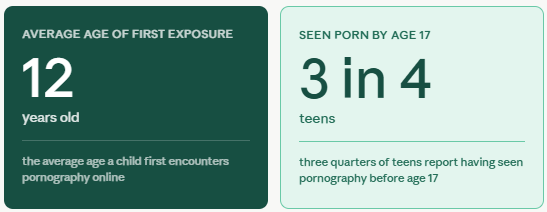
The adolescent brain is in a critical window of development — highly plastic, and uniquely vulnerable to forming lasting behavioral patterns. Pornography exploits this by flooding reward circuits with dopamine at levels that natural stimulation cannot match. The consequences are well documented: distorted views of sex and consent, increased risky sexual behavior, negative body image, elevated anxiety and depression, impaired judgment and emotional regulation, and pornography addiction.
For youth already navigating questions about their identity, these risks are compounded. Online spaces can feel like a natural place to explore — but they are also where pornography is most accessible and least filtered.
____________
Are Institutions Making Things Worse?
A growing number of institutions, acting in the name of supporting LGBTQ+ youth, have implemented policies and practices that may be accelerating the very risks documented above. Two domains deserve particular scrutiny.
1. California's School System
California has enacted a series of laws and policies that formally introduce questions of sexual identity and gender to students beginning in elementary school. When children encounter these concepts before they have the developmental tools to process them, the result can be identity confusion — unanswered questions that drive them online for answers. That road, as this research shows, often leads not to clarity but to exploitation, pornography, and deeper confusion.
Key policies:
FAIR Education Act (SB 48, effective 2012) — Requires LGBTQ+ identity and contributions to be included in history and social science instruction across all grades, including elementary school. Parents cannot opt students out of this curriculum.
California Healthy Youth Act (Ed. Code § 51933–51934) — Requires LGBTQ+-inclusive sexual health education at least once in middle school and once in high school. Parents may opt their child out by submitting a written request to the school.
AB 1955 — The SAFETY Act (effective January 2025) — Prohibits school districts from mandating that staff notify parents of a student's sexual orientation or gender identity. Courts have repeatedly pushed back. As of mid-2026, the U.S. Supreme Court has affirmed that parents have a constitutional right to be informed if their child exhibits symptoms of gender incongruence at school.
Several Bay Area districts go well beyond these minimums. San Francisco Unified is among the most prominent examples.
SFUSD distributes an 18-page teaching guide — LGBTQ Family + Gender Diversity: Teaching Guide for Elementary Grades — instructing educators to "explore integrating LGBTQ themes and weaving information about LGBTQ family and gender diversity into your teaching throughout the school year." The guide explicitly states that teaching "queer and trans identity affirming lessons is mandated by SFUSD policy and the CDE and does not require parental permission, nor does it require parental notification." This applies beginning in kindergarten.
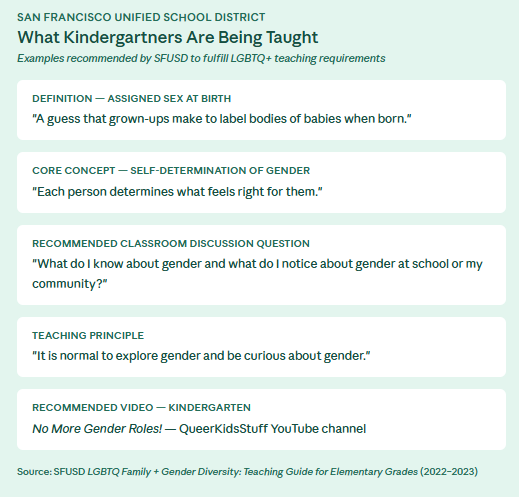
This is not a one-time lesson. The concepts build year over year — from gender curiosity in kindergarten to gender self-determination and LGBTQ social movements by fifth grade. Beginning at age five, these questions are woven through every grade, every year.
2. Healthcare Providers
California's major healthcare systems have formally introduced questions of sexual orientation and gender identity into routine adolescent care — and they are doing so earlier than most parents realize. At Kaiser Permanente, one of California's largest healthcare systems, gender identity screening begins at age 12 as part of routine well-child visits.
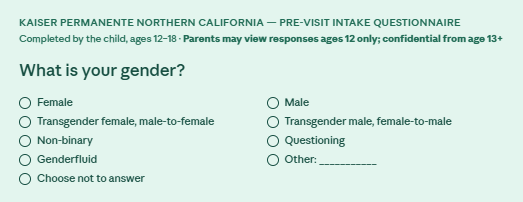
The child fills it out alone — and under California's confidentiality laws, parents have no right to see the responses.
A Kaiser Permanente study on this practice reveals something worth pausing on: adolescents who were asked about gender identity in the clinical questionnaire were significantly more likely to identify as transgender or gender diverse than those who were not asked. The question itself appears to shape the answer. Under California's confidentiality laws, parents may never know these conversations happened — leaving a newly questioning child to navigate those questions without parental guidance.
____________
The Cost of Looking Away
The data is clear. Youth exploring questions of sexual identity face dramatically elevated risks online — pornography exposure, grooming, blackmail, and the sharing of exploitative imagery. They are going online earlier, spending more time there, and landing in adult-oriented spaces at rates that should alarm anyone who cares about child safety.
The institutions that should be their partners in protection are often doing the opposite — introducing identity questions before children are developmentally ready, while limiting the parental visibility that might otherwise catch a problem early. The result is children going online for answers. And online is where the risks are waiting.
Child safety does not have a political party. It requires honest reckoning with what the evidence actually shows — even when the findings are uncomfortable.
