
Prescriptions for Death
What California data reveals about the rise of assisted death.
September 20, 2026
Physician-assisted death is often assumed to be a Canadian or European story — a trend happening elsewhere, not close to home. It's closer than most people realize. California physicians, many of them affiliated with major Bay Area hospital systems, are writing more of these life-ending prescriptions every year.

In California, deaths under the End of Life Option Act have grown from roughly 150 a year in 2016 to well over 1,200 in 2025 — with the Bay Area alone accounting for nearly a third of them statewide.
The legal term for this is the End of Life Option Act (EOLA) — a process that allows a terminally ill adult, with a prognosis of six months or less, to request medication from their physician that they self-administer, typically at home, to end their life. It's distinct from natural death, from declining further treatment, and from the comfort and hospice care many families already know. It's its own legal pathway, and it's growing fast.
This piece traces that growth starting just north of the border, where Canada's assisted-dying program has evolved rapidly since 2016 and offers the closest preview of where a newly legalized law can head. From there: California's own numbers, the Bay Area's outsized role, and what it means for the wider community.
____________
Canada: The Line That Keeps Moving
Canada legalized Medical Assistance in Dying (MAiD) in 2016 — the same year California's EOLA law took effect. The two countries make a useful comparison because they started from a similar place and diverged in how fast the practice grew and how far its eligibility expanded.
By 2024, MAiD accounted for 16,499 deaths in Canada in a single year — about 5.1% of all deaths nationwide. To qualify, a person must be a capable adult with a 'grievous and irremediable' condition: a serious, incurable illness causing intolerable, unrelievable suffering. The request must be voluntary, written, and witnessed, then assessed by two independent clinicians, with a reflection period in some cases.
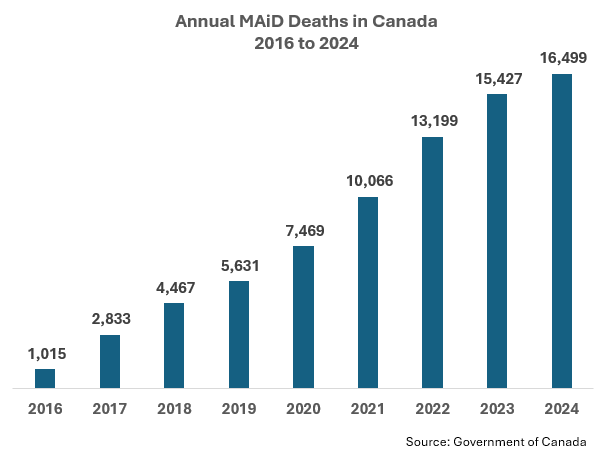
Two major changes made in 2021 have accelerated MAiD's growth:
Removed the mandatory 10-day reflection period for people with a terminal illness — eliminating a safeguard built into the original law for its core population.
Expanded eligibility to what's known as "Track 2": individuals whose natural death is not reasonably foreseeable, including people with chronic physical disabilities and other non-terminal conditions.
A law originally framed around imminent, terminal death, with a built-in waiting period, now moves faster and reaches considerably further than it once did.
Health Canada's reporting also tracks why people choose MAiD. The top reasons cited go well beyond unmanaged physical pain:
Inability to engage in meaningful activities
Loss of ability to perform activities of daily living
Loss of independence
Similar themes surface in California's numbers, with one notable difference: pain remains a top factor there, even as independence and daily function rank higher still.
____________
California: 48 Hours
Long before Canada legalized MAiD, the United States had already taken this step. Oregon's Death with Dignity Act — the nation's first physician-assisted death law, approved by voters in 1994 and in effect since 1997 — became the model California followed when it passed its own End of Life Option Act in 2015, effective June 2016. Under EOLA, an adult with a terminal diagnosis and a prognosis of six months or less can request prescription medication from their physician to end their life, following a defined process of oral and written requests.
That process changed in 2022. Senate Bill 380 reduced the mandatory waiting period between a patient's two required oral requests from 15 days to just 48 hours — cutting the reflection window the original law was built around by nearly 90%.
The medication itself is a compounded combination — typically digoxin, diazepam, morphine, amitriptyline, and phenobarbital — dissolved in liquid and self-administered unassisted, usually at home. By law, no physician, caregiver, or family member may administer it, and no IV option is permitted; the patient must be physically able to take it themselves, by mouth, feeding tube, or rectal catheter.
The growing adoption of assisted death is clear. According to the California Department of Public Health (CDPH), annual EOLA deaths rose from 151 in 2016 to at least 1,235 in 2025, an over 700% increase.
More people using EOLA means more prescriptions written. What stands out is the size of the gap: 604 more prescriptions than deaths in 2025 alone, nearly 50% higher. That gap isn't one story. Some patients die of their illness before taking the medication, others obtain a prescription and never use it, and some fill it one year but take it the next, or their outcome isn’t captured.
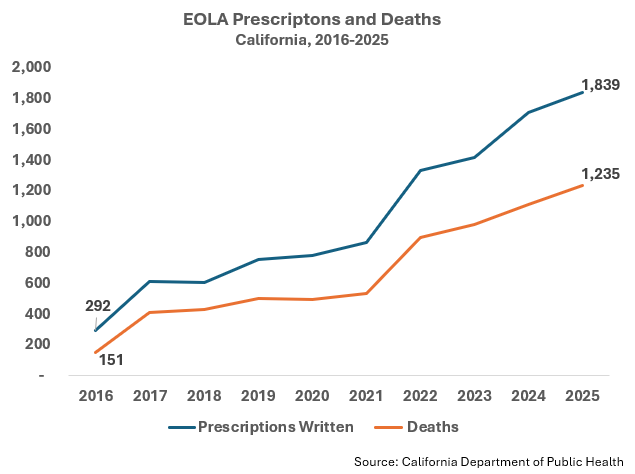
Because EOLA medication isn't listed as the cause of death on death certificates, and outcomes aren't always fully tracked, the true number of deaths is likely higher than what's reported.
Despite that gap, CDPH data on documented cases shows a consistent demographic picture:
86.7% are White
75.2% have at least some college education
63.9% have cancer as the underlying diagnosis, followed by cardiovascular and neurological conditions such as ALS
CDPH also tracks why participants request EOLA. The most-cited reasons:
96.1% loss of enjoyable activities
94.7% loss of autonomy
84.9% inadequate pain control
84.1% loss of dignity
The independence and daily-function findings echo Canada's closely. Pain is the one place the two diverge: it doesn't appear among Canada's top reasons, but it's cited by a large majority of California participants.
____________
Bay Area: 22% of the People, a Third of the Deaths
The CDPH's 12-county Bay Area region holds roughly 22% of California's population but accounts for 30–35% of all EOLA deaths statewide.
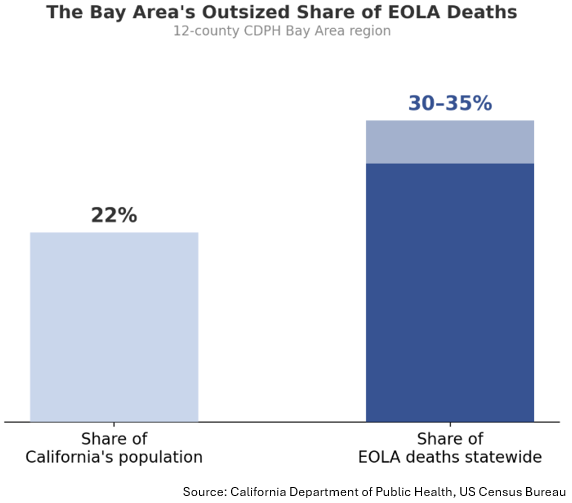
Statewide, only about 4 in 10 California hospitals permit EOLOA at all — meaning roughly 60% decline to participate, according to a survey of state hospitals. A likely driver of the Bay Area's numbers is the region's concentration of major non-religious medical centers — unlike Catholic-affiliated systems such as Providence and Dignity Health, which decline to participate in EOLA altogether. Some Bay Area systems aren't just permitting it. They're thought leaders in how to practice it.
UCSF Health has has built a structured process for patients requesting EOLA and leads ongoing research on the law, including peer-reviewed studies on safeguards such as the role of psychiatric consultation.
Kaiser Permanente, Stanford Health Care, and John Muir Health are among the other major Bay Area systems with institutional policies supporting EOLA participation.
This isn't a fringe practice happening quietly at the margins of the healthcare system. It's built into the standard operating procedure of some of the most respected hospitals in the region — which may be why the Bay Area's numbers run ahead of the state as a whole.
____________
Closer to Home
Independence and the ability to carry out daily life rank among the top reasons for choosing assisted death in both countries, often ahead of unmanaged pain. Diagnosis matters, but so does how supported someone feels while living with it.
Loss of independence can be eased
Losing the ability to carry out daily activities is a fear a community can help answer — not through legislation, but through practical support: meals, transportation, mobility help, caregiving relief, and simply showing up.
For readers of faith: 'I praise you because I am fearfully and wonderfully made' (Psalm 139:14) is a reminder that no one's worth depends on how much they can do for themselves. Needing help with daily life doesn't change that, and it's a chance for faith communities and neighbors alike to show it.
Comfort and hospice care as the practical answer
The most direct response to these fears is investment in comfort and hospice care that treats pain, isolation, and loss of purpose together. Bay Area nonprofits like Hospice East Bay already provide this kind of care, and faith-based visitation ministries such as SpiritCare Ministry to Seniors — which sends volunteer pastors and lay visitors into more than 90 Bay Area care communities each month — show what consistently showing up actually looks like in practice.
The weight families carry afterward
The impact doesn't end with the patient. Qualitative research on MAiD in Canada has found that bereaved family members often carry guilt, judgment, and secrecy alongside their grief — feelings the process rarely prepares them for. Some described the experience as crossing a moral line they never expected to cross, complicating their bereavement in ways ordinary grief support isn't built to address.
The word the law avoids
California's statute is explicit: actions taken under EOLA "shall not constitute suicide." Physicians list the underlying illness as cause of death, or simply write "pursuant to the End of Life Option Act." The word suicide never appears, by design, reportedly to protect life insurance payouts from suicide-exclusion clauses and preserve confidentiality. But a person who deliberately ends their own life by self-administering a prescribed drug is doing exactly what that word describes. The American Medical Association still uses it, calling physician-assisted suicide "fundamentally incompatible with the physician's role as healer."
What major faith traditions say
Most major religious traditions have historically opposed assisted dying, prioritizing life's preservation over relieving suffering. The vast majority of the world's faith communities, together representing roughly three in four people worldwide, hold this position:
Christianity (Catholic and most Protestant): only God has authority over life and death
Islam (Sunni and Shia): life is a trust from God that cannot be relinquished
Hinduism and Buddhism: caution against hastening death, tying its timing to karma
Judaism — mostly opposed, with Reform Judaism the exception
Despite real theological differences, these traditions largely agree here: suffering is part of life, not a reason to end it.
____________
Beyond Legislation
The data from Canada, California, and the Bay Area point to a consistent pattern: independence and daily function, not physical suffering alone, drive most requests for assisted death. That's the real issue, whatever the paperwork calls it: a dying person is being offered a way to end their own life as the answer to fear and loss of function. The toll doesn't end there. Families are often left carrying guilt and grief the process never prepared them for.
Shrinking safeguards haven't caused this, but they've made it easier to reach. California's waiting period fell from 15 days to 48 hours in six years; Canada's eligibility expanded within five. That trend continued in 2025: SB 1196, a bill to expand eligibility further, stalled in committee, though Governor Newsom signed SB 403 that same year, making the law permanent by repealing its 2031 sunset clause. The offer itself hasn't changed. There's simply less time to sit with it before deciding.
The legislative fight is quiet right now, but it isn't over. Many other opportunities lie outside Sacramento: supporting an independent nonprofit like Hospice East Bay, volunteering with a visitation ministry like SpiritCare Ministry to Seniors, checking on a neighbor facing a long illness. Congregations without a caregiving ministry have a chance to start one — a meal train, a phone tree, a list of people willing to sit with someone through chemo or hospice. Each one honors someone's dignity in a small, concrete way.
