
The Disappearing Rec Coach
Who will coach when California's youth sports mandates push volunteers off the field?
October 18, 2026
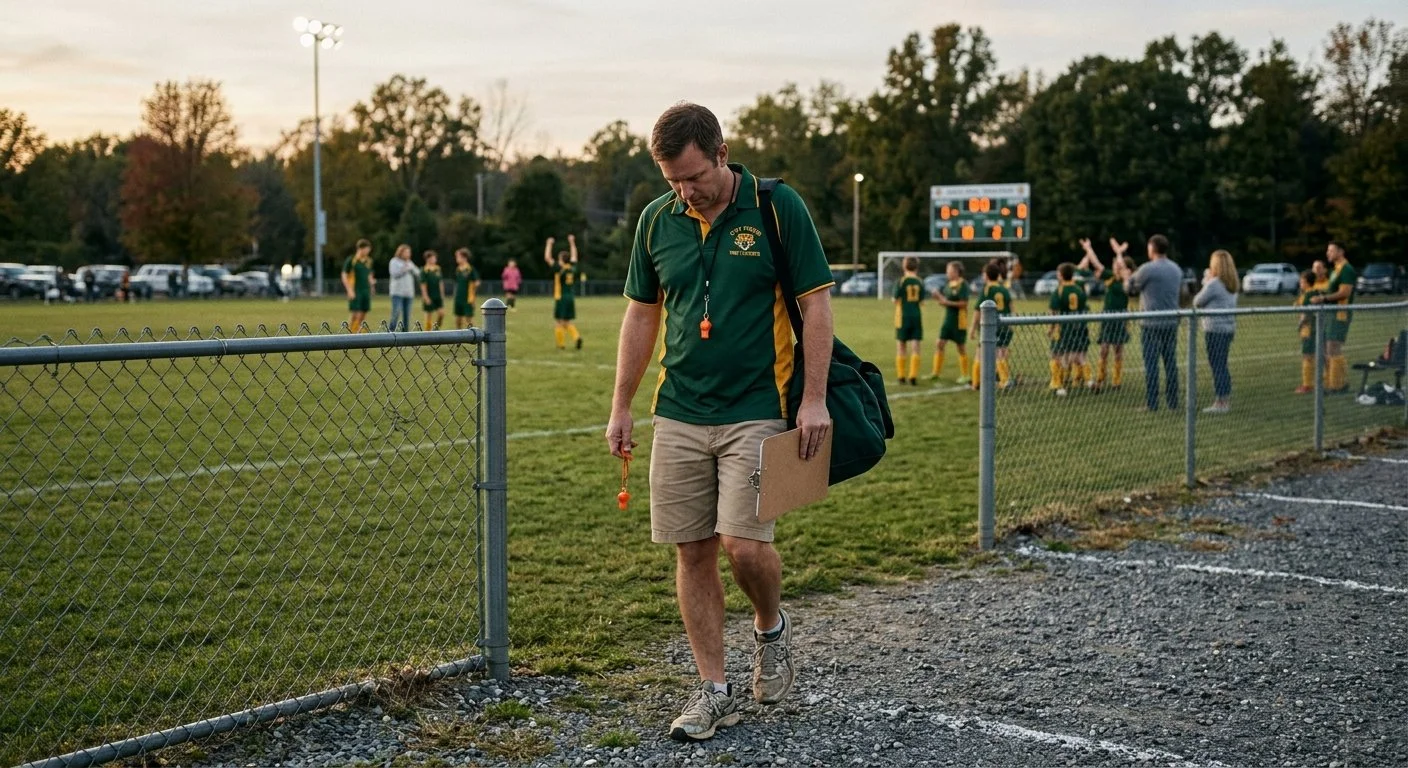
There was a time when volunteering to coach a local youth rec team took a willingness to help, a few hours a week, and a good attitude. Casual volunteers were the backbone of community youth sports.
Those days are over.
82% of park and recreation agencies report a shortage of volunteer coaches, the most common challenge they face in running youth sports.
— National Recreation and Park Association
Today, a parent who wants to coach youth sports in California isn't just signing up to help. Between state law and league policy, they are expected to serve as a compliance administrator, trained child-abuse reporter, a concussion and cardiac-warning spotter, and (starting in January 2027) a CPR- and AED-certified first responder.
While these rules were written to protect children and the leagues that serve them, the requirements keep escalating, and their combined weight is creating a painful reality. Unpaid, busy parents are being asked to carry so many legal, medical, and administrative roles that “casual volunteer” is no longer an option. The pool of available coaches is stretched thin, and the leagues that can least afford it are feeling it first.
____________
The Pre-Season Gauntlet
To understand why community leagues are increasingly short on help, look at what a single parent must complete before they can run a practice.
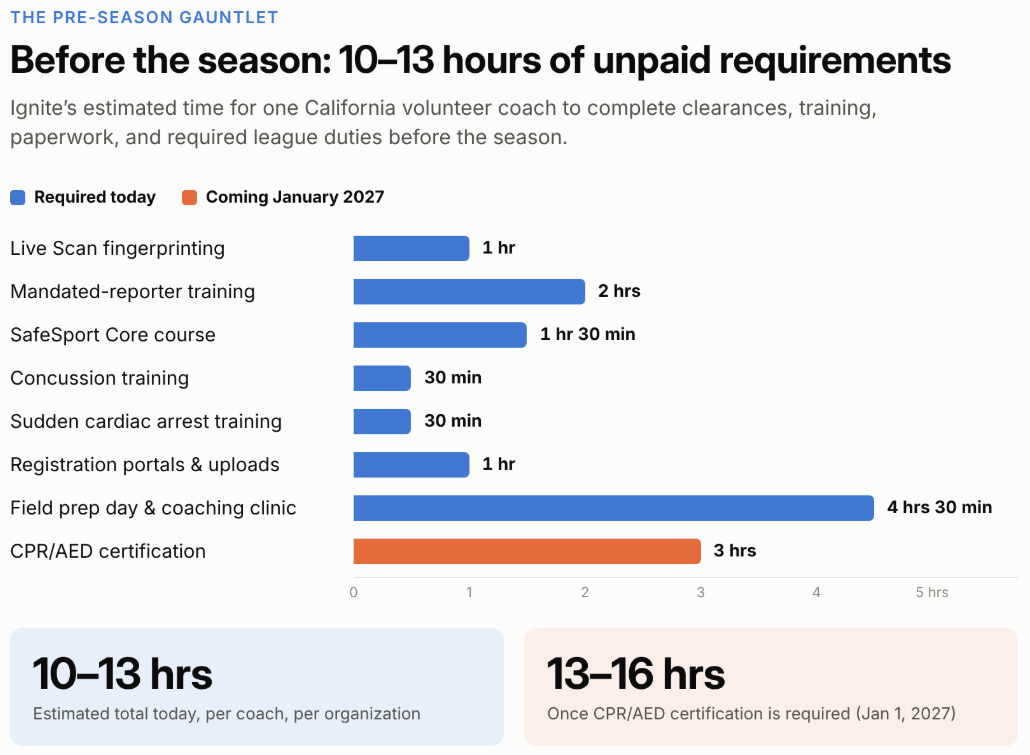
Live Scan fingerprinting (AB 506). Every regular volunteer (anyone giving 16+ hours a month or 32+ a year) must be fingerprinted through California's Live Scan system, usually during business hours at a processing site. Results can't be transferred between organizations, so a parent who coaches soccer, helps with Little League, and volunteers at school may be fingerprinted three times.
Mandated-reporter training. AB 506 also requires training in recognizing and reporting child abuse. Many governing bodies add their own course on top, such as the 90-minute U.S. Center for SafeSport Core course common in soccer, with annual refreshers.
Concussion and cardiac training. State law (AB 2007 and AB 379) requires coaches to learn when to pull a player showing signs of a head injury or cardiac distress.
Governing-body requirements. National organizations add their own layers. Little League, for example, runs a separate annual background check, so California volunteers often clear two, and requires tournament coaches to complete its Diamond Leader training.
Duplicate paperwork. Different sports use different technology platforms, so a parent coaching two sports manages separate accounts and re-uploads the same certificates to each.
Add mandatory field-prep days and in-person coaching clinics, and our estimate is that a parent coach invests 10 to 13 hours of unpaid administrative time just to get cleared to coach. That figure is set to grow in 2027, when CPR/AED certification becomes mandatory.
____________
How the Rules Piled Up
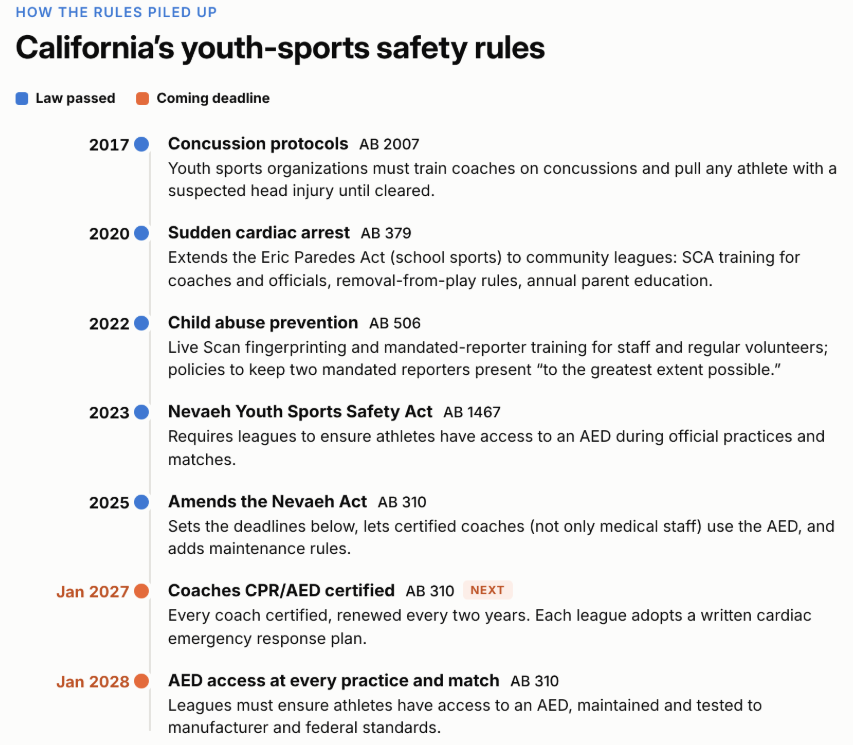
None of these requirements arrived at once. In less than a decade, California’s safety rules have steadily escalated: from concussion training, to cardiac arrest protocols, to fingerprinting and abuse-prevention policies. Two of the biggest deadlines are still ahead: CPR/AED certification for every coach in 2027, and AED access at every practice and game in 2028. Each law targeted a single concern on its own, but the volunteer is often the one left carrying them all.
____________
The Broken Math of "Free" Labor
California's youth sports rules apply equally to every organization, from private clubs with paid coaches to rec leagues run by parent volunteers. What differs is the ability to absorb the cost. Higher-fee clubs can often hire staff and build compliance into their fees, while low-cost community leagues must rely on volunteers and tight budgets.
Consider a typical 500-player community league. Forty teams need 80 coaches. AB 506 requires leagues to adopt policies keeping two mandated reporters present "to the greatest extent possible," and leaves each league to decide what that means. Some rely on open fields with parents nearby. Others, mindful of liability and insurers who can ask for proof of compliance, require a second cleared adult with every team. In those leagues, if one coach is stuck in Bay Area traffic, practice is theoretically canceled unless a backup can step in.
Add backup adults and a dozen board members, and this example league must recruit and clear 132 volunteers every season. Real programs across the Bay Area, from AYSO soccer and Little League baseball to parish-based CYO leagues, face the same challenge. Most run largely on parent volunteers, and many add their own background checks and training on top of the state’s.
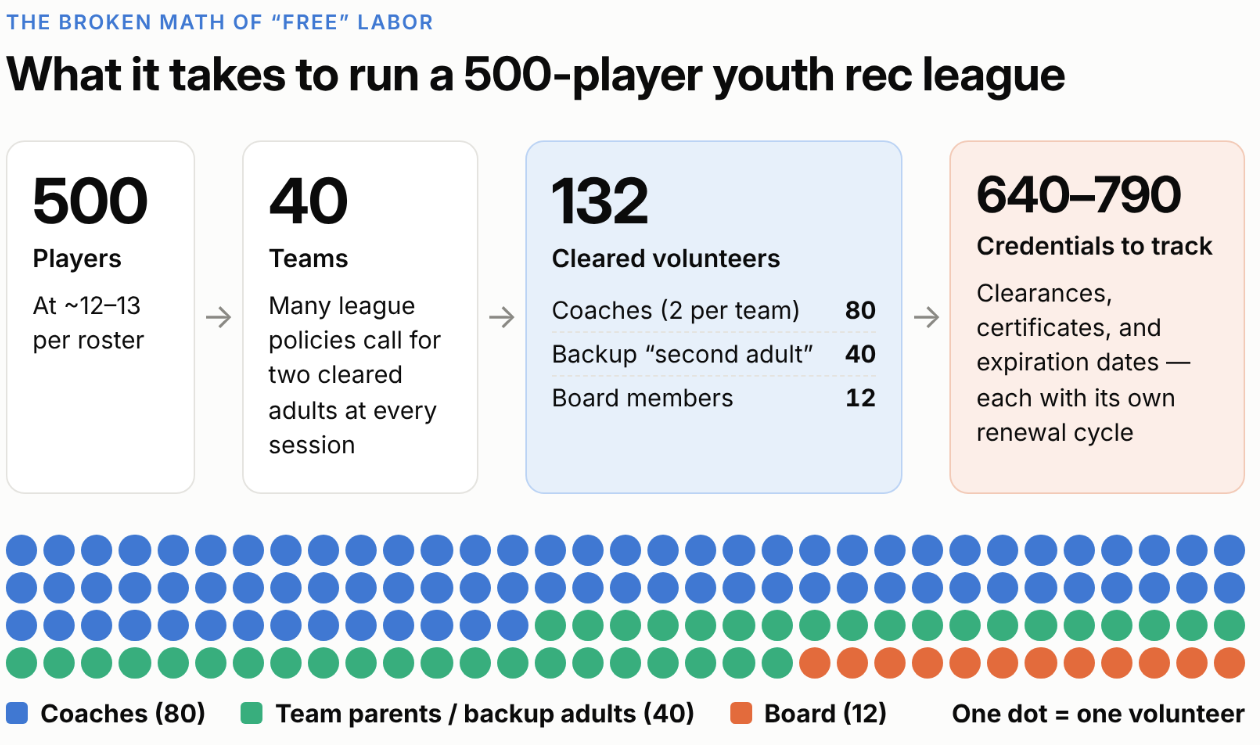
Multiply those volunteers by the trainings, clearances, and renewal dates each must keep current, and the paperwork quickly runs into the hundreds, often spread across several different systems. For some volunteers, it adds up to a part-time job, without the pay.
____________
The Real Risk: Empty Sidelines
When volunteering becomes time-consuming and complicated, fewer parents raise their hands. Park and recreation agencies already name the shortage of volunteer coaches as their top challenge in running youth sports, and every rec league that depends on parent volunteers is exposed.
Rec leagues exist to keep sports affordable and open to every child. But each new requirement adds to the time, training, and costs that volunteers and league budgets have to absorb. Families are already feeling the squeeze: the Aspen Institute reports that youth sports costs have risen 46% since 2019. When leagues can’t find enough cleared volunteers or cover rising costs, they shrink teams, raise fees, or cut programs, and the impact is felt most in communities where a rec league is the only option.
The result could be empty sidelines on Saturday mornings, not for lack of kids, but for lack of cleared, certified adults to coach them.
With each new law, the bar for volunteering has risen, and in 2027 and 2028 it will rise again. Community youth sports were built by parents who simply said yes. The question now is how we can make it possible for the next parent to say yes, too.
